
Teamsters Local 667
Memphis Strong — carrying the legacy of 1968
Powering · Labor Education
The Memphis & West Tennessee AFL-CIO Central Labor Council recommends a NO vote on all three amendments, standing with the Tennessee AFL-CIO, which recommends NO on all three. Alongside the recommendation you will find the official ballot text, what a yes and a no each do, what is at stake for working families, the honest argument on the other side, and who is paying for the campaigns. Read it and judge it for yourself.
3 Amendments.
No on All Three.
Bail. A permanent ban on state property taxes. A rewrite of crime victims' rights. All three change the Tennessee Constitution, which means they outlast every politician on the same ballot. None of them mention unions, and all three reach working families — through the job a member loses sitting in jail before trial, through the only tax the state will have left, and through what happens at a picket line that ends in a criminal charge.
More yes votes than no votes.
Yes votes must be more than half of all votes cast in the governor's race.
Add every vote cast for every candidate for governor, divide by two, and an amendment has to beat that number in yes votes alone. So a member who votes for governor and then skips the amendment questions has effectively voted no — their ballot still counts in the denominator. The amendments are printed directly after the governor's race, which is exactly where people stop reading.
Vote all the way to the end of the ballot. However a member decides to vote on these three, the worst outcome for us is a ballot that goes blank after governor.
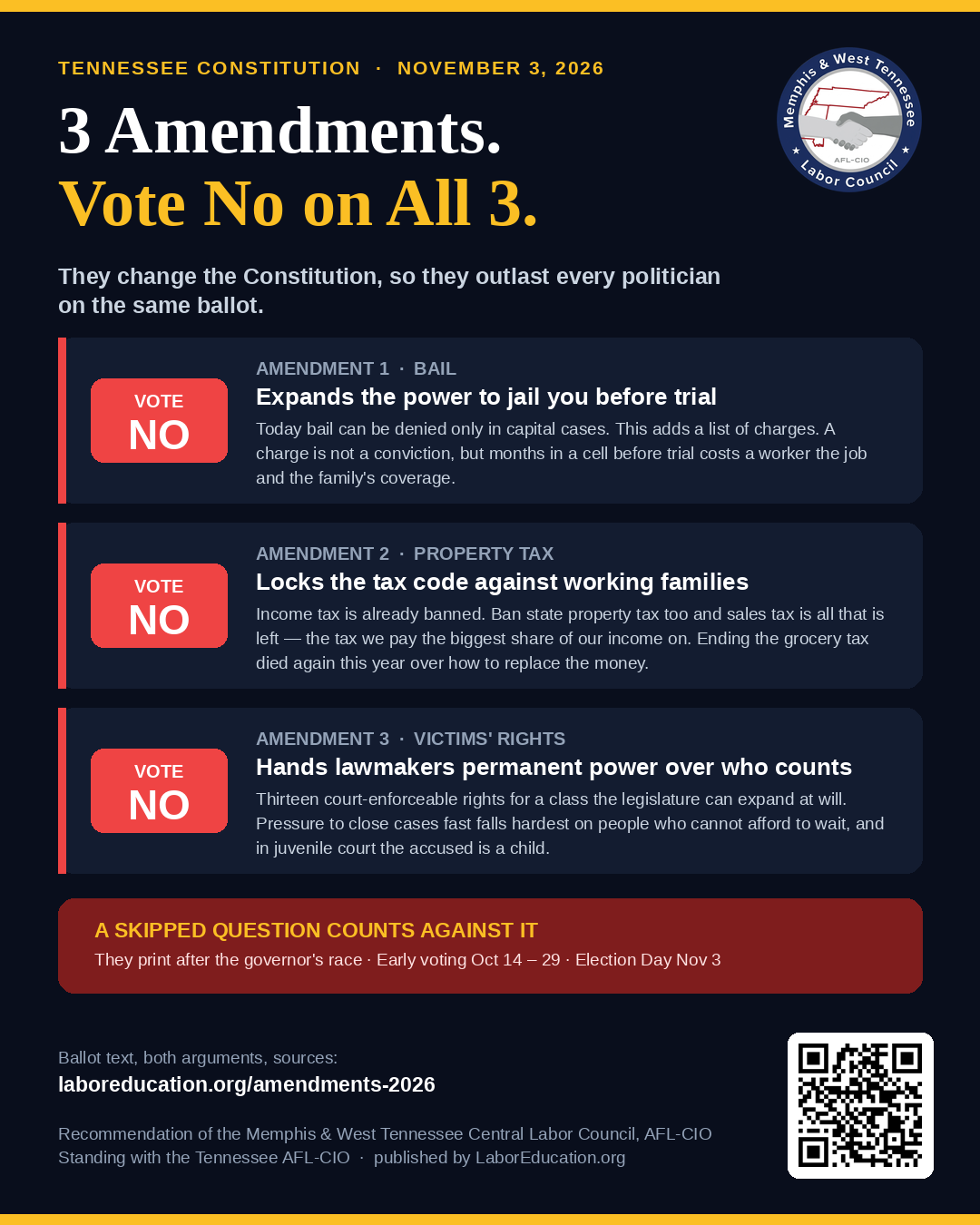
All three amendments, the recommended vote on each, the rule that a skipped question counts against it, the Labor Council seal and a QR code back to this page — in English or Spanish, dark for posting or white to run off on a copier. Hand it to a member who has fifteen seconds and send them here when they have five minutes.
All prisoners shall be bailable by sufficient sureties unless for the following when the proof is evident or the presumption great: (1) A capital offense; (2) An act of terrorism; (3) Second degree murder; (4) Aggravated rape of a child; (5) Aggravated rape; (6) Grave torture; and (7) Any other offense for which, as of November 3, 2026, a defendant, if convicted, could not be released prior to the expiration of at least eighty-five percent of the entire sentence imposed.
Since 1796 the Tennessee Constitution has allowed bail to be denied only in capital cases when the proof is evident. This replaces that rule with six named offenses plus a seventh catch-all tied to sentencing law, and requires a judge to state on the record the reasons for granting or denying bail in those cases.
Courts could hold a person without bail before trial on any of those charges — including everything inside the 85% category.
The current rule stands: bail is available except in capital cases where the proof is evident or the presumption great.
- It expands the government's authority to jail people before they are convicted of anything. That is the whole of it, and no amount of framing changes it.
- This is not a money bail question — denial applies regardless of what you can pay. The harm lands downstream: a worker held before trial loses the job, loses the coverage, and takes the plea to get out, while a defendant with resources waits with private counsel and fights.
- It arrives on top of jails already past capacity and a county budget already carrying the cost.
No attendance or job-abandonment language in any of our contracts survives months in pretrial custody. Just cause cannot save a member who cannot report for work, and when the job goes the family's health coverage goes with it. Every added month of pretrial detention is a termination nobody gets to arbitrate.
The Department of Correction reported 41 Tennessee jails operating at 90% of capacity or higher in July 2026. More pretrial population in the same buildings means mandatory overtime, worse staffing ratios, more assaults and more turnover — carried by the people who work the floor.
TDOC paid $161.7 million in county and local jail reimbursements in fiscal year 2024–25. In Shelby County the jail is already the heaviest line in the budget, and pretrial population is what crowding is made of. Detention competes with county worker wages and with every other county service.
Because the text reads “at least eighty-five percent,” it also captures the offenses requiring 100% service. That list runs through murder in the first and second degree, especially aggravated kidnapping, aggravated kidnapping, especially aggravated robbery, aggravated robbery, rape, rape of a child, aggravated sexual battery, aggravated arson, aggravated child abuse and the child-exploitation offenses. Voters will see six crimes printed and one cross-reference to the sentencing code.
Two things cut the other way, and they are real. The catch-all is frozen “as of November 3, 2026,” so a future legislature cannot quietly widen the no-bail list by moving more crimes into the 85% column — undoing that freeze would take another constitutional amendment. And the amendment requires judges to put their reasons in the record either way, which is more transparency than the rule we have now.
In accordance with the following provisions, all property real, personal, or mixed shall be subject to taxation, but the Legislature shall not levy, authorize, or otherwise permit any state tax upon such property, and the Legislature …
Tennessee has not levied a state property tax since 1949, but the General Assembly still holds the power to bring one back. This removes that power permanently. City and county property taxes are not affected and are not on the ballot. Reversing it later would take two-thirds of two separate legislatures plus another statewide vote.
The legislature is permanently barred from levying a state property tax.
Nothing changes today. There is still no state property tax; the legislature simply keeps the authority it has never used since 1949.
- We are trying to get the tax off groceries and replace the revenue. The 2026 repeal died over exactly that question — how to replace $800 to $885 million a year. This amendment permanently removes one of the few broad-based answers left.
- Income tax is already constitutionally banned. Lock property too and the only lever left is the sales tax working families pay the biggest share of their income on.
- Nobody raised a dollar against it and no opposition committee exists. If it fails, it fails on turnout alone.
The very section this amendment edits already bans any state or local tax on payroll or earned personal income — that was the 2014 amendment. Add a property tax ban and the state has constitutionally written itself out of both. What is left is sales tax: the most regressive tax there is, the one our members pay the largest share of their income on, and the most volatile when the economy turns.
If the state cannot touch income or property, a downturn leaves two options: raise the tax working families pay most of, or cut schools, TennCare and public payroll. Our public-sector affiliates sit closest to that decision, and they are the ones who feel it first.
School funding runs on state sales tax plus local property tax. A state permanently barred from property tax guarantees schools stay dependent on the local base — and the bases are not equal. Per the Comptroller's figures, Shelby County carries the highest county property tax rate in Tennessee and Memphis the highest city rate. This amendment protects the arrangement that leaves Memphis property owners paying the steepest local rates in the state.
Under this same section, a residential building with two or more rental units is assessed as commercial property at 40% of value. Property tax is already inside the rent. Nothing in this amendment lowers it.
The property tax bill a Memphis homeowner actually pays is local. This amendment cannot touch it. Any claim that it gives homeowners relief or certainty on their bill is describing something the text does not do.
Reported through June 30, 2026. No committee has registered in opposition and no opposition campaign exists.
Also endorsing a YES vote: Americans for Prosperity–Tennessee, Americans for Tax Reform, NFIB–Tennessee, the Beacon Center of Tennessee, the Tennessee Chamber and the Tennessee Farm Bureau.
Nobody is proposing a state property tax, local taxes are untouched, and no dollar changes hands either way. The only elected official on record against it argues that it is unnecessary, that it could carry unintended revenue consequences and that it may touch the state's bond rating — not that it does immediate harm. A NO vote does not create a tax. It declines to close a door.
Shall Article I, Section 35 of the Constitution of Tennessee be amended by deleting the section in its entirety and substituting the following: … a victim, as defined by law and which may be expanded by the General Assembly, shall have the following rights, which shall be protected … (thirteen enumerated rights follow).
The existing victims' rights section is deleted and replaced with thirteen specific rights a victim can ask a court to enforce — notice, presence, being heard at release, plea, sentencing and parole, protection from harassment, restitution, speedy disposition, and more. This is the national Marsy's Law model. The General Assembly defines who counts as a victim, and the text says that definition “may be expanded.”
Article I, Section 35 is replaced with the thirteen-right list, enforceable in court in the manner the legislature provides.
The current victims' rights section stays in the constitution as written.
- It hands the General Assembly permanent power to decide who counts as a victim, and makes thirteen rights enforceable in court for whoever ends up inside that definition. A due process savings clause is a rule of interpretation, not a limit on the legislature.
- Picket lines produce criminal complaints. If a supervisor is the complainant, right (6) reaches “the accused or any person acting on behalf of the accused” — broad enough to touch a union representative.
- The pressure in right (9) to close cases fast falls hardest on defendants who cannot afford to wait, and in juvenile proceedings the accused is a child.
Trespass, property damage, an alleged assault at a gate. If a plant manager or a supervisor is the complainant, right (6) gives them an enforceable constitutional interest in protection “from the accused or any person acting on behalf of the accused.” That last phrase is broad enough to reach a union representative or a defense investigator. Employers already use criminal process as leverage in a labor dispute; this adds a handle to pull.
Right (9) creates a constitutional interest in a speedy disposition and a “prompt and final conclusion.” A member fighting a picket-line charge usually benefits from time to build a defense. Pressure for speed is pressure to plead.
Rights (4), (5) and (11) give victims a formal role in release and parole decisions and require that safety be weighed before release. More participation tends to mean longer custody — which runs straight into second-chance hiring and the pre-apprenticeship pipelines we are building.
Somebody has to do all of that notifying, conferring and informing: court clerks, the District Attorney's victim-witness staff, parole staff — county and state employees, many of them represented. In other Marsy's Law states this arrived as an unfunded mandate on local courts. Nobody has shown us a fiscal note for Shelby County.
The worst Marsy's Law outcome elsewhere was police agencies using victim status to withhold the names of officers in use-of-force cases. Florida did it until the Florida Supreme Court quashed the practice in November 2023; South Dakota's Supreme Court went the other way in April 2026. Both turned on a clause letting victims withhold identifying information. Tennessee's thirteen rights contain no such clause — there is no anonymity or confidentiality right here. But the constitution hands the definition of “victim” to the legislature and says it may be expanded. That protection lives in statute, not in the constitution.
This is a more carefully drafted version than Florida's, and the safeguards are in the text, not just in the summary. It says the section “must be interpreted to preserve and protect the rights of all persons to due process.” It creates no basis for vacating a conviction, no cause of action for damages against the state or its employees, and it does not restrict the District Attorney General or the inherent authority of the court. A victim asserts these rights “not as a party.” The ACLU's objection is structural rather than textual: it deletes the existing section outright, and the sharpest risk sits in juvenile proceedings, where the accused is a child.
- 1A fiscal note on Amendment 3's notification duties — what the thirteen rights cost the Shelby County courts, the clerks and the District Attorney's victim-witness staff, and whether any money follows the mandate.
- 2Shelby County's own pretrial population and current jail capacity measured against the six named offenses plus the 85% category, so Amendment 1 can be argued with local numbers instead of statewide ones.
- 3Getting our public-sector affiliates on the record on Amendment 2's revenue lock, since their jobs and their members' schools sit closest to it.
Offense lists for the 85% category come from Tenn. Code Ann. § 40-35-501. The Florida ruling is Florida Supreme Court, No. SC2021-0651 (Nov. 30, 2023); the South Dakota ruling issued April 22, 2026. Positions shown for the ACLU of Tennessee and the Tennessee Republican Party are their own, as published. The Tennessee AFL-CIO recommends NO on all three, reported to affiliates by the State Federation.
Analysis and recommendation of the Memphis & West Tennessee AFL-CIO Central Labor Council, published by LaborEducation.org, standing with the Tennessee AFL-CIO's recommendation of NO on all three.
Support This Project
This page is built and maintained by the Union Strong Labor Education App — a free platform built by the labor movement, for the labor movement.
Or donate directly: